How to get your business recommended by ChatGPT and other AI assistants
Many customers now ask ChatGPT, Perplexity, Gemini or Google's AI Mode who to call, and get two or three names back. This guide explains how those names are chosen, what an SME can do on its own website and elsewhere, and how to check where you stand without buying a tool.
AI assistants such as ChatGPT recommend businesses they can find through search and confirm in other sources: your website, business listings, reviews and mentions on other sites. Nobody can buy or guarantee a recommendation, but you can make your business easy to find, easy to understand and consistent everywhere it appears. Then you ask the same customer questions every month and record whether you are mentioned.
Do people really ask AI assistants to recommend local businesses?
Yes, and the share is growing fast. In BrightLocal's 2026 survey of 1,002 US adults, 45% had used an AI tool to get a recommendation for a local business, up from 6% a year earlier (BrightLocal, 2026). People still check: 97% read online reviews when choosing a local business.
The catch is that AI assistants name very few businesses. In SOCi's 2026 study of more than 350,000 business locations, ChatGPT recommended 1.2% of them, while 35.9% appeared in Google's local map results (SOCi via Localogy, 2026). Being one of the few names in an answer is worth a lot, and it is hard to get.
How do AI assistants choose which businesses to recommend?
They search, read what they find and name the businesses that several sources agree on. The details differ between assistants, but the steps are much the same:
- They turn the question into searches. ChatGPT search rewrites a question into one or more targeted queries, sends them to the search providers it works with and uses the person's general location to make local results more accurate (OpenAI). Google's AI Overviews and AI Mode run several related searches across subtopics, a method Google calls query fan-out (Google, 2025).
- They look in a search index. Each company runs crawlers that read websites: OAI-SearchBot for ChatGPT search, PerplexityBot for Perplexity and Googlebot for Google. OpenAI says sites that block OAI-SearchBot are not shown in ChatGPT search answers (OpenAI).
- They read the sources. Your website, business listings, review sites, local news and articles that mention you.
- They cross-check and choose. A business that appears with the same details in several trusted places is easier to recommend than one that appears once.
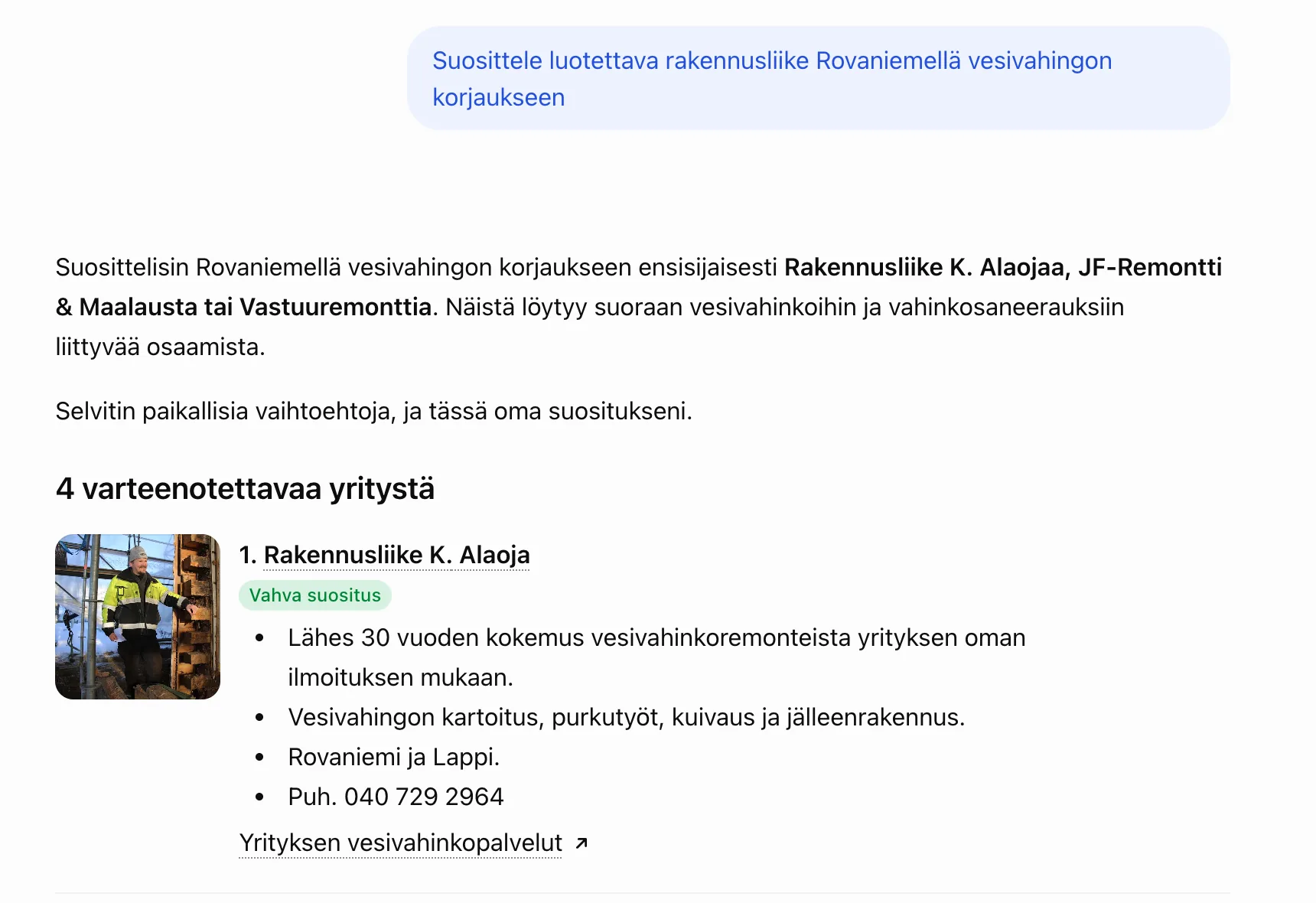
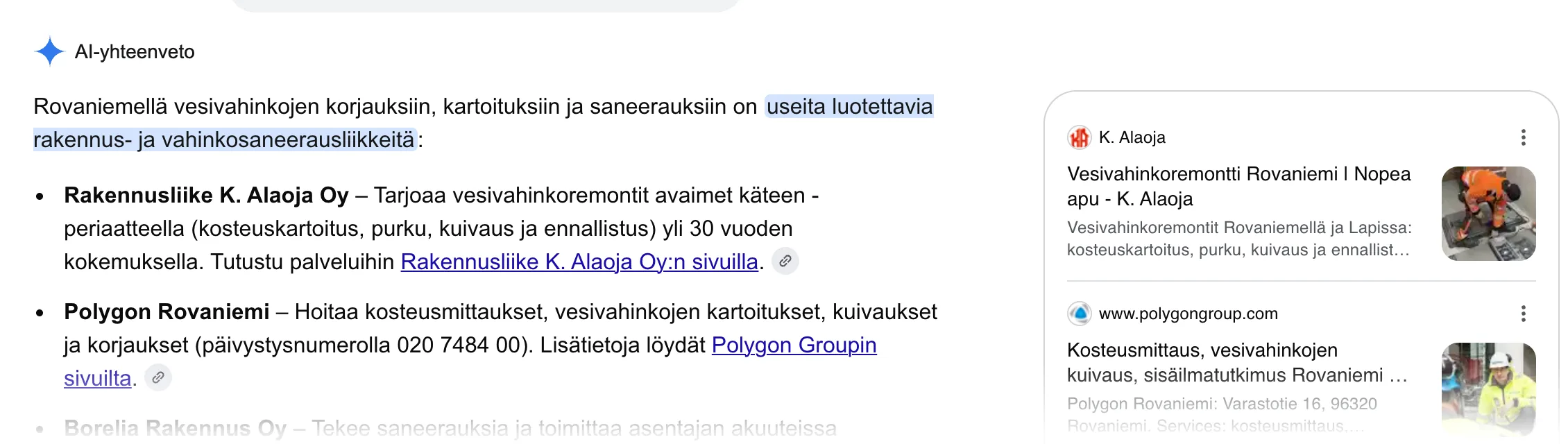
Real screenshots, unedited apart from cropping. Answers change from day to day, so we repeat the questions and report the share of runs.
Where do AI assistants get their information about local businesses?
Mostly from sources a business can manage itself. Yext analysed 6.8 million citations in answers from Gemini, OpenAI and Perplexity and found that 86% came from sources brands manage or strongly influence: websites made up 44%, business listings 42%, and reviews and social media 8% (Yext, 2025).
The strongest independent evidence comes from a 2026 study that checked every one of 4,776 restaurants, cafés and bars in two areas of Bali against 2,208 answers from ChatGPT, Claude, Gemini and Perplexity (Pitenin, 2026). 85.6% of the venues were never recommended by any of the four. The ones that were named were more likely to have the following:
| Factor | Odds ratio for being recommended |
|---|---|
| Their own website | 1.92 |
| More reviews | 1.64 |
| Prices listed online | 1.54 |
| Mentions on other websites | 1.44 |
| A higher star rating | 0.89 (no clear effect) |
An odds ratio of 1.92 means the odds of being named were almost twice as high. Star rating didn't decide whether a venue was included, but among those that were, a higher rating made first place more likely. The study covered hospitality, not trades, so treat it as a strong pointer rather than a rule for every sector.
Why do ChatGPT, Perplexity and Google give different answers?
Because each one searches in its own way and leans on different sources. A September 2026 study asked ChatGPT, Microsoft Copilot, Google and Perplexity the same 15 commercial questions and compared the web pages they cited (Tannenbaum, 2026). 84.9% of engine pairs did not share a single cited page, and 96.4% of all cited pages appeared in only one engine. The same engine also changed 67% of its cited pages from one day to the next.
The lists of businesses overlap a little more than the cited pages do. In the Bali study, the top 20 venues named by different assistants overlapped by only a third to a half (Pitenin, 2026). That has three practical consequences:
- Check each assistant separately. Showing up in ChatGPT tells you little about Perplexity or AI Mode.
- Never judge from one answer. Ask the same question several times.
- Be present in many places. Every engine draws on different sources, so consistency across your website, listings and reviews gives each of them a way to find you.
What does an AI assistant need to know about your business?
It needs to recognise your business as one clear entity: one name, one location and one set of services, confirmed in several places. An entity is anything a search system can identify as a distinct thing, such as a company, a person or a place, and attach facts to. If your website says "Mäkinen Roofing", your Google profile says "Mäkisen Kattotyö Oy" and a directory still lists an old phone number, an assistant may treat them as three businesses, or trust none of them.
- Services
- Service area
- Prices
- Opening hours
- Phone
- Reviews
- Your website
- Google Business Profile
- Directories
- Review sites
An old phone number in one directory makes the facts disagree. Fixed, every source tells the same story.
Illustration: how AI assistants connect facts about a business from several sources.
These are the facts that matter most for a local service:
- Who you are: the exact company name, written the same way everywhere.
- What you do: each service in the words customers use ("roof replacement", not "building envelope solutions").
- Where you work: your address and the towns or areas you serve.
- What it costs: prices, price ranges or what a typical job includes.
- Why you can be trusted: reviews, years in business, certifications and real projects with photos.
- How to reach you: phone number, email and opening hours.
What can you do on your own website?
Make every fact easy to find, easy to read and the same as everywhere else. Google's guide to its AI search features says the basics of good search still apply, and that you don't need special files, special markup or content rewritten for AI (Google, 2026). These are the steps we take on every site we build:
- Give every main service its own page. A roofing company in Tampere gets separate pages for roof replacement, roof repairs and gutters, each saying what the job includes, where you do it and who it is for.
- Show prices where you can. A starting price or a typical range answers the question buyers ask first, and listed prices were linked to more recommendations in the Bali study (Pitenin, 2026).
- Answer first, in plain sentences. Start each section with the answer to the question in its heading. Short, factual sentences are easy for people and machines to quote.
- Write what only you know. Google asks for content based on first-hand knowledge rather than a rewrite of what is already online (Google, 2026). A car repair shop that explains which faults it sees most often after the first frost has something no template site has.
- Show proof on the page. Reviews, project photos, the year you started, certifications and the people who do the work.
- Let the crawlers in. Allow Googlebot, OAI-SearchBot and PerplexityBot in your robots.txt, and make sure your text is in the page itself rather than loaded later by scripts.
- Add structured data. LocalBusiness markup repeats your name, address, phone number and opening hours in a format machines read directly. Google says it isn't required for its AI search, but recommends keeping it as part of good search practice (Google, 2026).
- Keep it fast on phones. A slow page loses the visitor an assistant sent you. Our guide to a good PageSpeed score explains what to aim for.
What can you do outside your website?
Make sure the places assistants cross-check say the same thing as your website, and keep them active. Business listings made up 42% of the citations in Yext's study, almost as much as websites (Yext, 2025).
- Complete your Google Business Profile. Google says Business Profiles can help your services appear in its AI responses as well as in regular results (Google, 2026). Fill in every field: categories, services, areas served, hours and photos.
- Claim your other listings. Apple Business Connect, Bing Places and the directories that matter in your country and trade. Use exactly the same name, address and phone number as on your website.
- Ask every happy customer for a review. More reviews were linked to more recommendations (Pitenin, 2026), and the locations ChatGPT recommended in SOCi's study averaged 4.3 stars (SOCi via Localogy, 2026).
- Reply to your reviews. 89% of consumers expect owners to respond (BrightLocal, 2026). A short, personal reply also adds fresh, specific words about your work.
- Earn real mentions. A story in the local paper, a supplier's reference page, your trade association's member list or the youth team you sponsor. Mentions on other websites were linked to more recommendations (Pitenin, 2026), while Google warns that chasing inauthentic mentions isn't as helpful as it might seem (Google, 2026).
- Clean up old details. Search for your business name and correct every outdated address, phone number or name.
How do you check whether AI assistants recommend you?
Ask the same set of customer questions in each assistant every month, several times each, and record every answer in one of three states. Single checks mislead: a 2026 statistical study found that one-off visibility measurements give "a misleadingly precise picture" and that many differences fall within the measurement noise (Sielinski, 2026).
- Write ten real questions. Use your customers' words and include the place: "Who does roof replacement in Tampere?", "Reliable car repair in Rovaniemi for a Volkswagen?", "Kitchen renovation company in Espoo with fixed prices?"
- Choose the assistants that matter. ChatGPT, Perplexity, Google AI Mode, Gemini and Copilot are a good start.
- Ask in a clean session. Use a new chat, logged out where you can, from the area you serve.
- Ask each question three times. Answers change between runs, so one answer is a sample, not a result.
- Record one of three states for every run. Use the table below.
- Repeat monthly with the same questions. Compare the share of runs in which you were mentioned, assistant by assistant.
| State | What it means | What to write down |
|---|---|---|
| Mentioned | The assistant names your business | Your position in the list and whether your site is linked |
| Not mentioned | It answered, but without you | Which businesses it named instead |
| Not measurable | No answer, a refusal, an error or a misunderstood question | Keep it separate, because it is not the same as zero |
A line in the log might read: "Who does roof replacement in Tampere?", ChatGPT, three runs, mentioned twice in second place, not mentioned once.
What doesn't work?
Shortcuts that promise AI visibility without making the business easier to verify. Most waste money, and some break the law.
- llms.txt as a visibility fix. llms.txt is a proposed text file that summarises a website for language models. Google says creating one will neither help nor harm your visibility in Google Search, although it's fine to keep one for other services (Google, 2026). We add one to the sites we build because it costs nothing, but we don't sell it as a way to get recommended.
- Keyword stuffing. Repeating "best roofer Tampere" twenty times does not help. In the research paper that introduced the term GEO, keyword stuffing gave little to no improvement in AI answers, while adding sources, quotations and statistics improved visibility by 30–40% in the authors' tests (Aggarwal et al., 2024). Google treats keyword stuffing as spam (Google, 2026).
- Fake reviews. Buying reviews, writing your own or generating them with AI breaks the FTC's 2024 rule in the US (FTC, 2024). In the UK, fake reviews are explicitly banned and the Competition and Markets Authority can fine a company up to 10% of its global turnover (CMA, 2025).
- Hundreds of thin pages. Mass-producing near-identical pages for every town or keyword is what Google calls scaled content abuse (Google, 2026).
- Guaranteed recommendations. No one controls what an AI assistant says. Google states that there is no way to request or pay for a better local ranking (Google Business Profile Help), and AI answers are even harder to predict.
How does Visuco work on this?
We build every page so AI assistants and search engines can read and trust it, and we measure what happens. That means a page for every service and area, prices where you want to show them, structured data, open access for crawlers and fast pages, plus a Google Business Profile and listings with the same details. Then we run your customers' questions in the main assistants and show you the results.
If most of your customers still come from Google, read what AI Overviews and AI Mode mean for local businesses. When an assistant does send people your way, the landing page structure that sells shows how to turn those visits into enquiries.
See our AI search optimization service
Questions about getting recommended by AI assistants
Can I pay ChatGPT to recommend my business?
No one can buy or guarantee a place in an AI assistant's answer. What you can do is make your business easier to find and confirm, which is what the steps in this guide are for.
Does ChatGPT use Google's search results?
ChatGPT search uses OpenAI's own crawler and works with other search providers that OpenAI doesn't list in full. Google's AI Overviews and AI Mode use Google's index. Doing well in Google helps, but it doesn't mean ChatGPT will name you.
Do I need an llms.txt file?
Not for Google, which says the file neither helps nor harms visibility in its search. It costs little to add, so we include one, but on its own it won't get a business recommended.
My rating is 4.9 stars. Why am I not recommended?
A high rating alone isn't enough. In the 2026 Bali study, having more reviews, your own website, listed prices and mentions on other sites were linked to being recommended, while star rating mattered mainly for position once a business was included (Pitenin, 2026).
How long does it take before AI assistants mention us?
Nobody can promise a timeline, because each assistant refreshes its sources on its own schedule. Fix the basics first, test the same questions every month and judge the trend over several months.
Sources
- BrightLocal, "Local Consumer Review Survey 2026", February 2026 www.brightlocal.com/research/consumer-review-survey
- Localogy, "SOCi LVI Report Reveals How AI Is Rewriting Local Search Visibility", January 2026 www.localogy.com/2026/01/soci-lvi-report-reveals-how-ai-is-rewriting-local-search-visibility
- OpenAI, "ChatGPT search" (help article), accessed October 2026 help.openai.com/en/articles/9237897-chatgpt-search
- OpenAI, "Overview of OpenAI crawlers", accessed October 2026 developers.openai.com/api/docs/bots
- Perplexity, "Perplexity crawlers", accessed October 2026 docs.perplexity.ai/guides/bots
- Google Search Central, "AI features and your website", December 2025 developers.google.com/search/docs/appearance/ai-features
- Yext, "AI citations: 86% of sources are brand-managed", October 2025 www.yext.com/blog/ai-citations-86-percent-of-sources-are-brand-managed
- Pitenin, "Invisible to the Machine: Auditing AI Restaurant, Cafe, and Bar Recommendation Against a Complete Market Census", arXiv, August 2026 arxiv.org/abs/2608.07069
- Tannenbaum, "Scoring With the Engine: Retrieval Exposure, Cross-Engine Divergence, and the Limits of Engine-Agnostic GEO Scores", arXiv, September 2026 arxiv.org/abs/2609.22655
- Google Search Central, "Optimizing for generative AI search", July 2026 developers.google.com/search/docs/fundamentals/ai-optimization-guide
- Sielinski, "Quantifying Uncertainty in AI Visibility: A Statistical Framework for Generative Search Measurement", arXiv, August 2026 arxiv.org/abs/2603.08924
- Aggarwal et al., "GEO: Generative Engine Optimization", KDD 2024 (arXiv) arxiv.org/abs/2311.09735
- Google Search Central, "Spam policies for Google web search", accessed October 2026 developers.google.com/search/docs/essentials/spam-policies
- Federal Trade Commission, "Federal Trade Commission Announces Final Rule Banning Fake Reviews and Testimonials", August 2024 www.ftc.gov/news-events/news/press-releases/2024/08/federal-trade-commission-announces-final-rule-banning-fake-reviews-testimonials
- GOV.UK, "CMA to boost consumer and business confidence as new consumer protection regime comes into force", April 2025 www.gov.uk/government/news/cma-to-boost-consumer-and-business-confidence-as-new-consumer-protection-regime-comes-into-force
- Google Business Profile Help, "Tips to improve your local ranking on Google", accessed October 2026 support.google.com/business/answer/7091
Keep reading
Google AI Overviews and AI Mode: what they mean for local businesses
What Google's AI Overviews and AI Mode change for local businesses, with click and prevalence data, and what still brings in calls.
Read the guideWhat is a good PageSpeed Insights score?
What Google PageSpeed Insights scores mean, what they measure, why they vary and what typically slows SME websites down.
Read the guideThe landing page structure that sells: 11 parts in the right order
The eleven parts of a landing page that sells, why the order matters and how the structure looks for a local service business.
Read the guide