- Home
- AI search
AI search optimization for SMEs
More and more buyers ask an AI assistant who to call, and it answers with a few names. AI search optimization makes your business one of them: we build every site so an assistant can find, understand and check your business, and we measure the result. Some call this generative engine optimization (GEO) or answer engine optimization; the work is the same.
AI search optimization means making your business easy for AI assistants such as ChatGPT, Google AI Mode, Gemini, Perplexity and Copilot to find, understand and trust. That takes a clear website of your own, the same facts about you everywhere online, reviews, listings on the sites AI engines read, and specific, current content. No one can guarantee a recommendation, but all of this can be built and measured.
How customers find a business now
We asked ChatGPT and Google for a builder in Rovaniemi on 31 October 2026. Both named our client first.
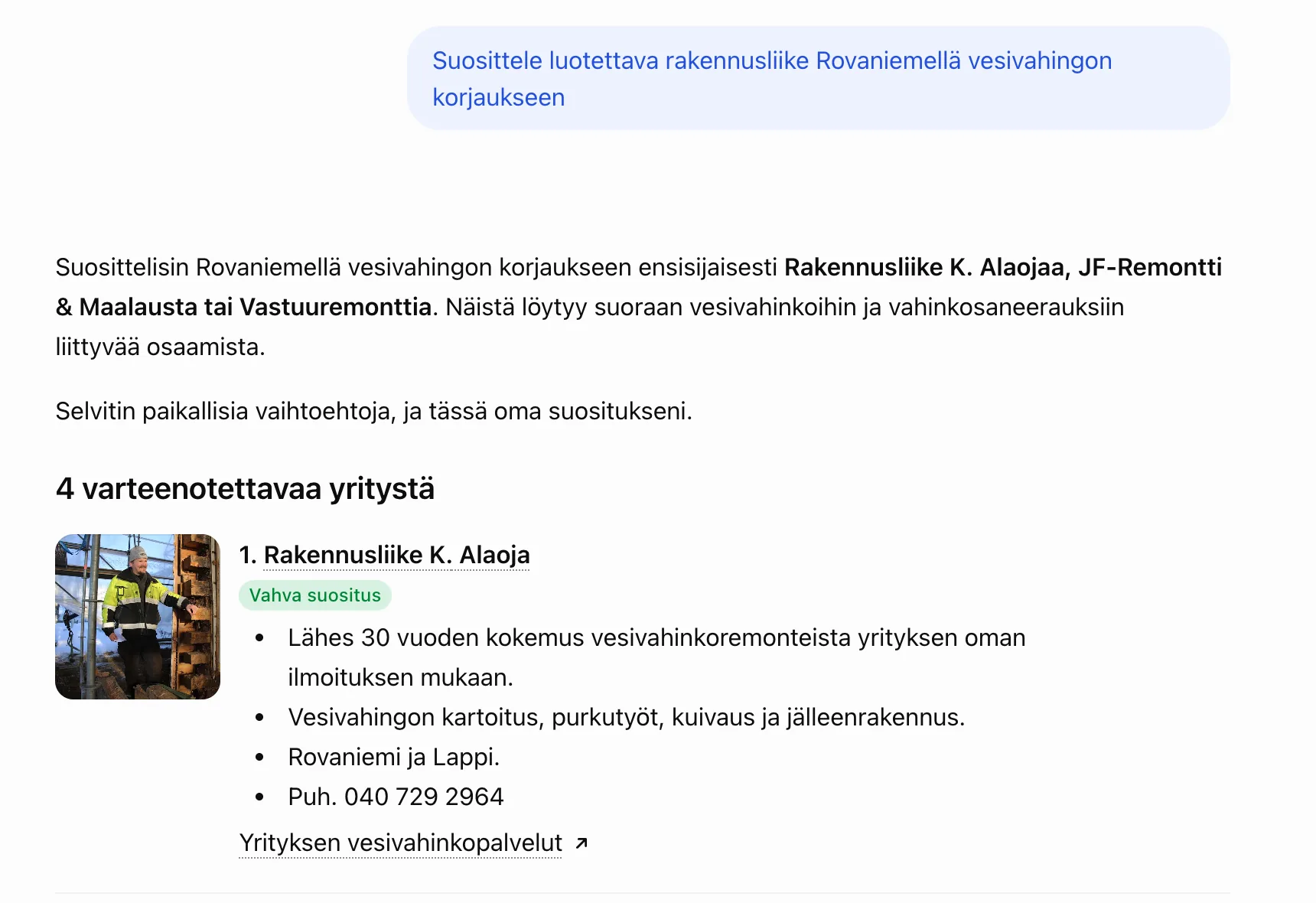
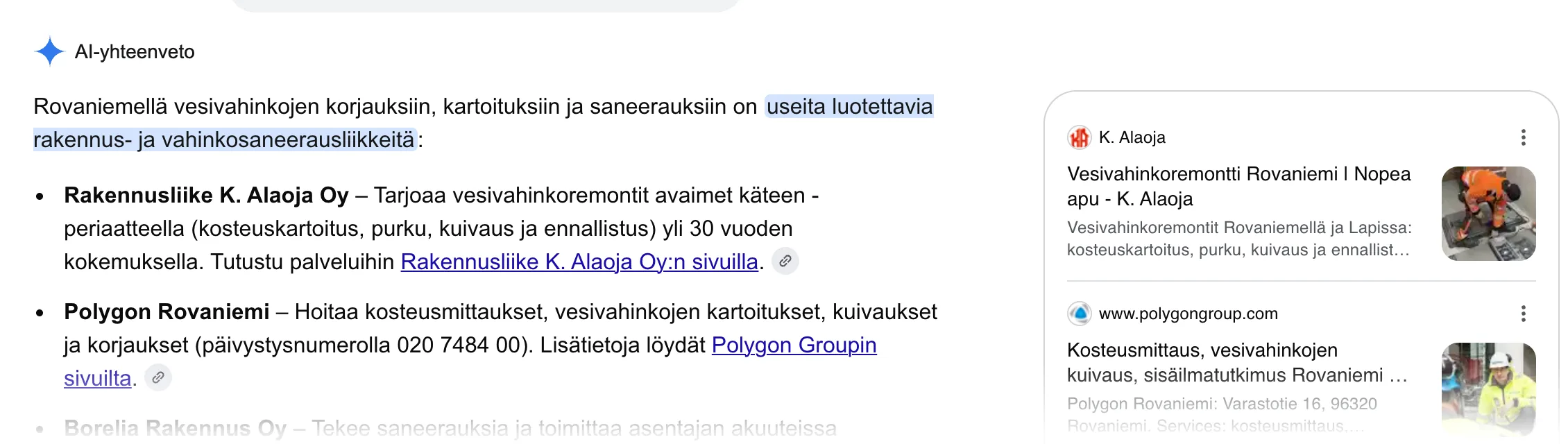
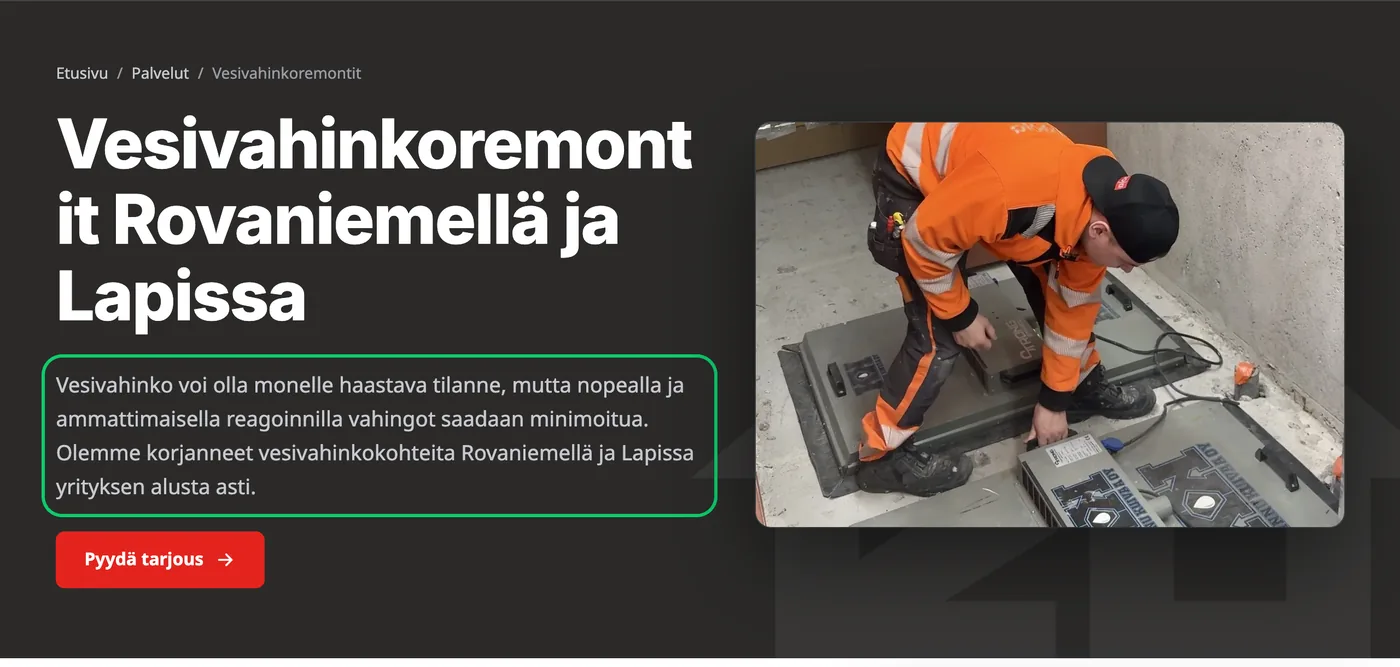
Real screenshots, unedited apart from cropping. Answers change from day to day, so we repeat the questions and report the share of runs.
What a buyer asks, and what the assistant answers
We asked ChatGPT for a trusted builder for water damage repair in Rovaniemi on 31 October 2026. Translated from Finnish; the unedited screenshot is above.
Recommend a trusted construction company in Rovaniemi for water damage repair.
For water damage repair in Rovaniemi I would recommend first Rakennusliike K. Alaoja, JF-Remontti & Maalaus or Vastuuremontti. All three have direct expertise in water damage and damage repair.
I checked the local options, and here is my own recommendation.
4 companies worth considering
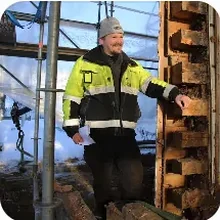
- Nearly 30 years of water damage repairs according to the company's own site.
- Damage mapping, demolition, drying and rebuilding.
- Rovaniemi and Lapland.
Re-enacted from the real answer, translated from Finnish. The unedited screenshot is above.
How AI connects the facts about your business
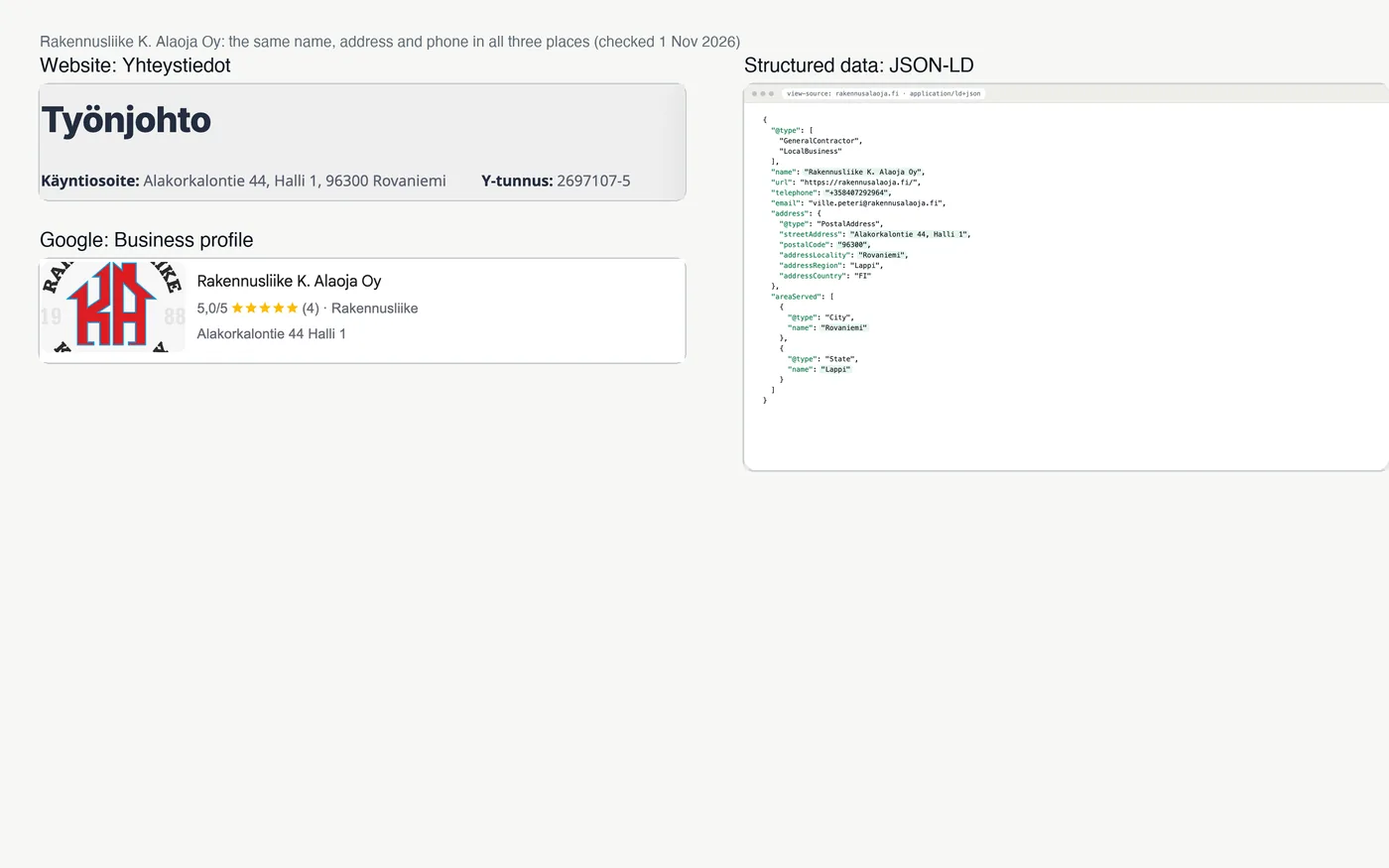
An AI assistant builds its picture of you from your website, Google Business Profile, directories, review sites, social profiles and local news. When they all agree, it can say it with confidence.
Search engines call this your entity. We keep the same name, address, phone, hours, services and service area on your site, in its structured data, in your Business Profile and in listings.
Illustration: how ChatGPT and other AI assistants build their picture of a business from several sources.
How is AI search changing the way people find local businesses?
The assistant names only a handful of businesses. In an answer with three names, the fourth business isn't there at all.
ChatGPT reached 900 million weekly users in February 2026 (TechCrunch, 2026). With an AI summary on Google, users clicked a regular link in 8% of visits, against 15% without one (Pew Research Center, 2025).
Most of this research is from the US; we've found no independent Nordic study of local searches, so we test them ourselves.
How do AI assistants decide which businesses to mention?

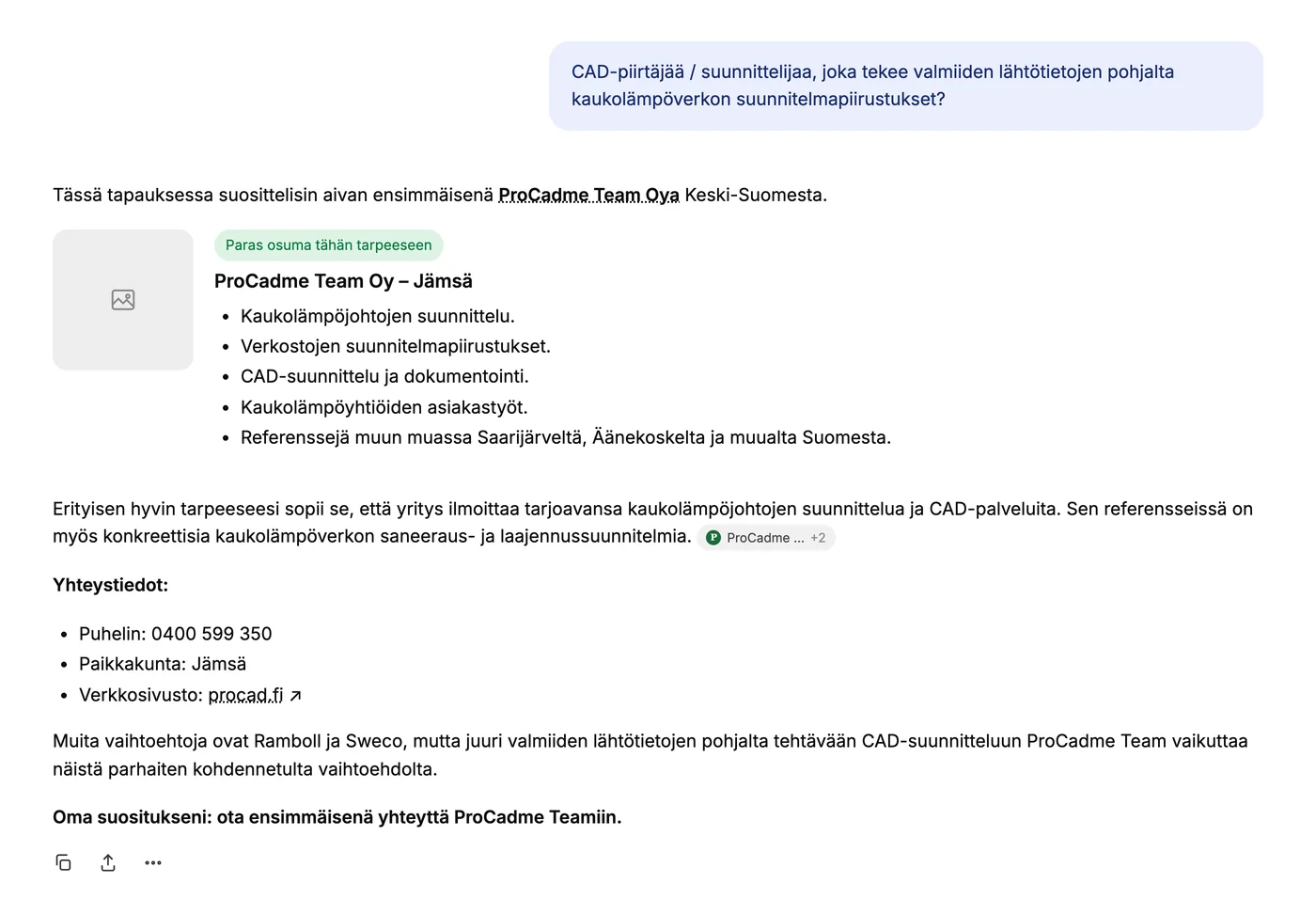
No one outside the AI companies knows the exact rules, but the research points to five things.
A clear website of your own
In a census of 4,776 Bali venues, those with a website had almost twice the odds of a recommendation from ChatGPT, Claude, Gemini or Perplexity; listed prices went with higher odds too (Pitenin, 2026).
The same facts everywhere
Engines read Google Maps, review sites, social profiles and your site; mismatched details can drop you from the answer (Localogy, 2026).
Reviews
Review count went with being recommended, star rating with being named first (Pitenin, 2026); ChatGPT's picks averaged 4.3 stars (Localogy, 2026).
Listings and mentions on other sites
Of 6.8 million AI citations, 44% came from businesses' own sites and 42% from listings such as directories (Yext, 2025); mentions elsewhere also went with higher odds (Pitenin, 2026).
Specific, current content
Google asks for "unique expert or experienced takes that go beyond common knowledge" (Google, 2026): your real prices, areas and projects.
Why is there no single trick?
Different AI engines rarely cite the same pages. In a September 2026 study of ChatGPT, Copilot, Google and Perplexity, 84.9% of engine pairs shared no cited page and 96.4% of cited pages appeared in only one engine (Tannenbaum, 2026).
Between two days in June 2026, about two thirds of each engine's cited pages for the same questions changed (Tannenbaum, 2026).
So we keep your facts clear and consistent everywhere the engines look. The research field calls this generative engine optimization, or GEO, a name from a 2023 paper (Aggarwal et al., 2023).
What AI search optimization adds to every site
Every site is written and coded so people, search engines and AI assistants can read and check it.
Answer-first service and area pages
Each opens with what you do, where, what it costs and how long it takes.
Structured data
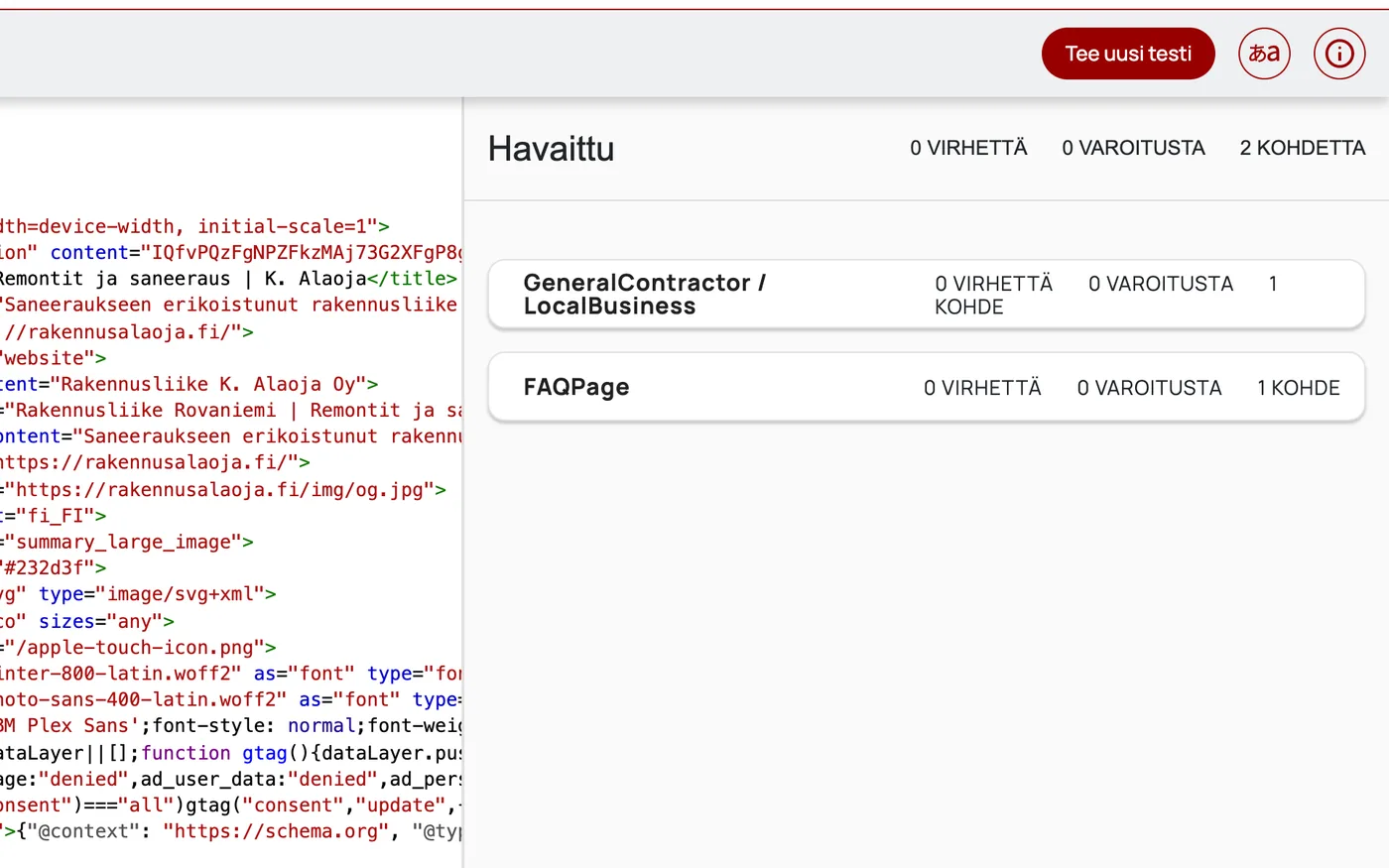
Name, address, services, hours and questions, machine-readable. Google recommends it (Google, 2026); Microsoft says schema helps Copilot (Search Engine Roundtable, 2025).
Consistent business facts
One master record, used everywhere.
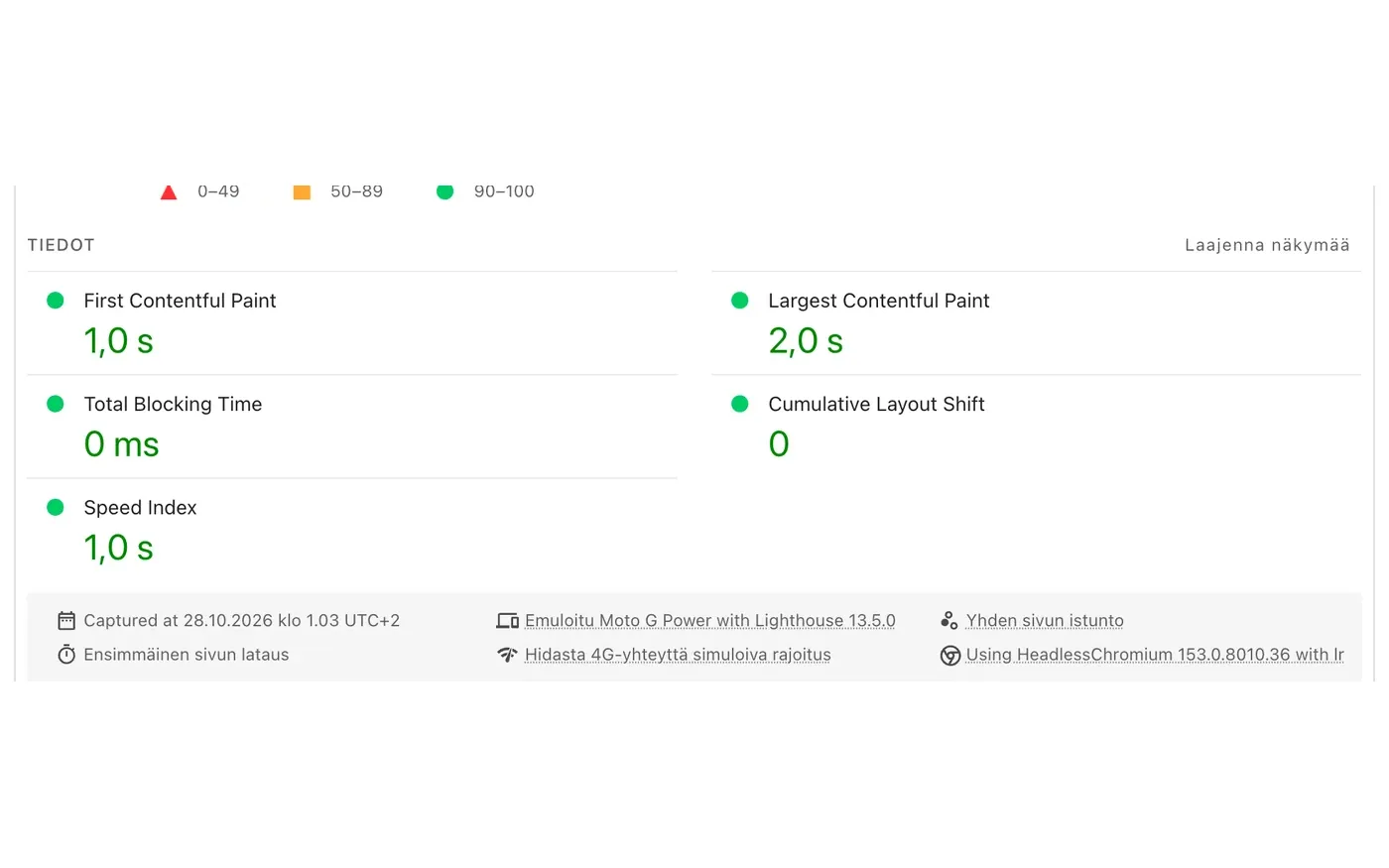
Fast HTML that works without JavaScript
Vercel found the main AI crawlers from OpenAI, Anthropic and Perplexity didn't run JavaScript (Vercel, 2024).
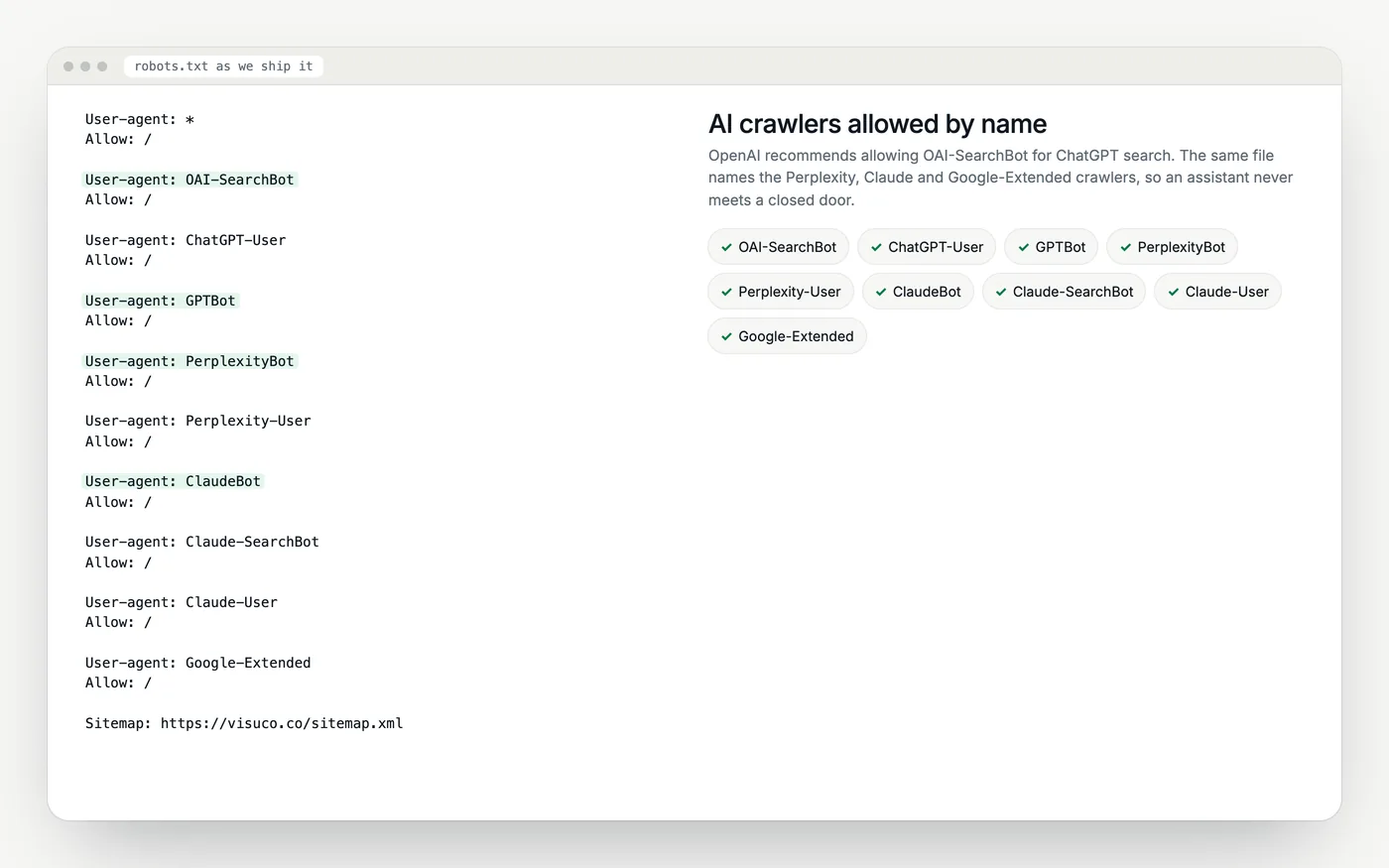
AI crawler access in robots.txt
OpenAI's OAI-SearchBot is allowed, as OpenAI recommends for ChatGPT search (OpenAI, 2026); Google's AI features use Googlebot. Training crawlers such as GPTBot are your choice.
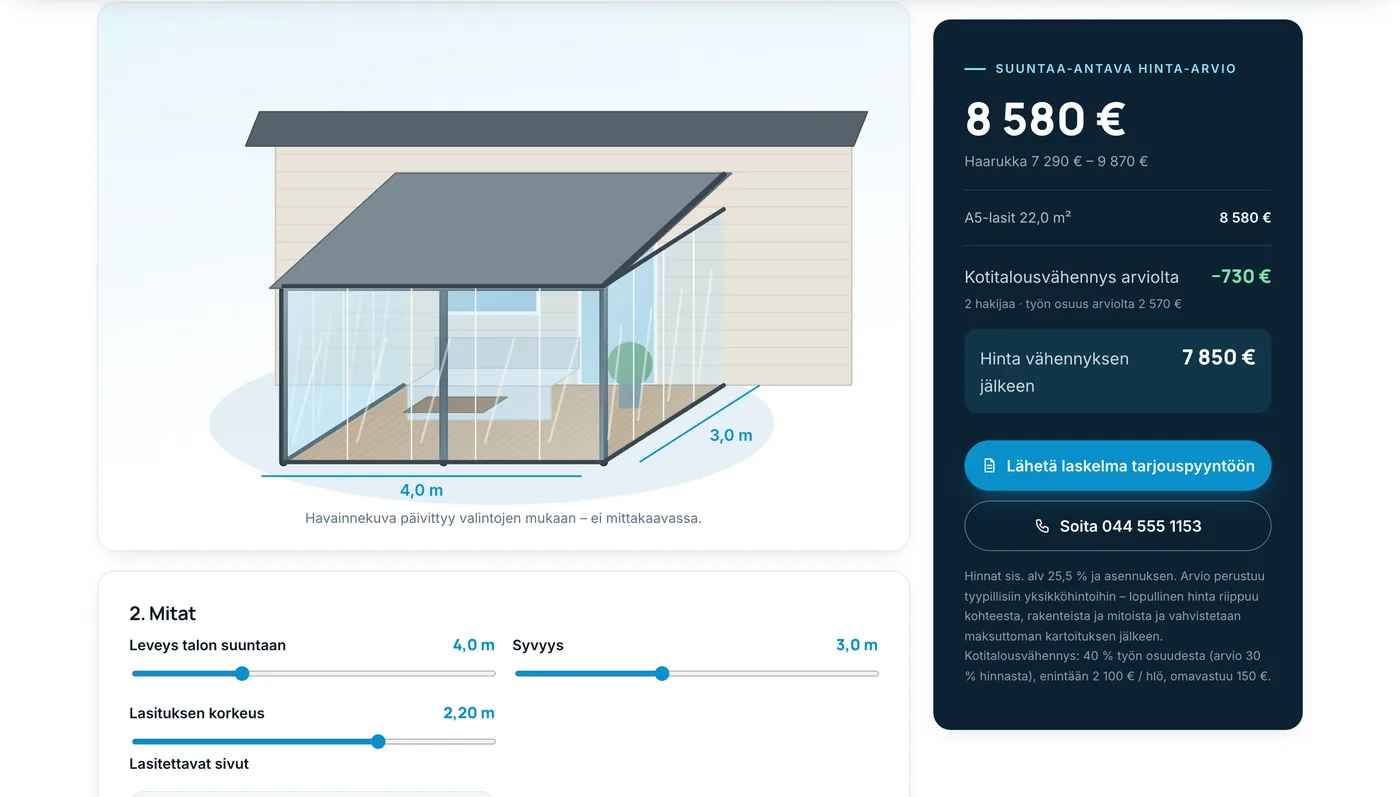
Prices and specifics in plain text
Price ranges or a price calculator, with the basics also as text an AI can read.
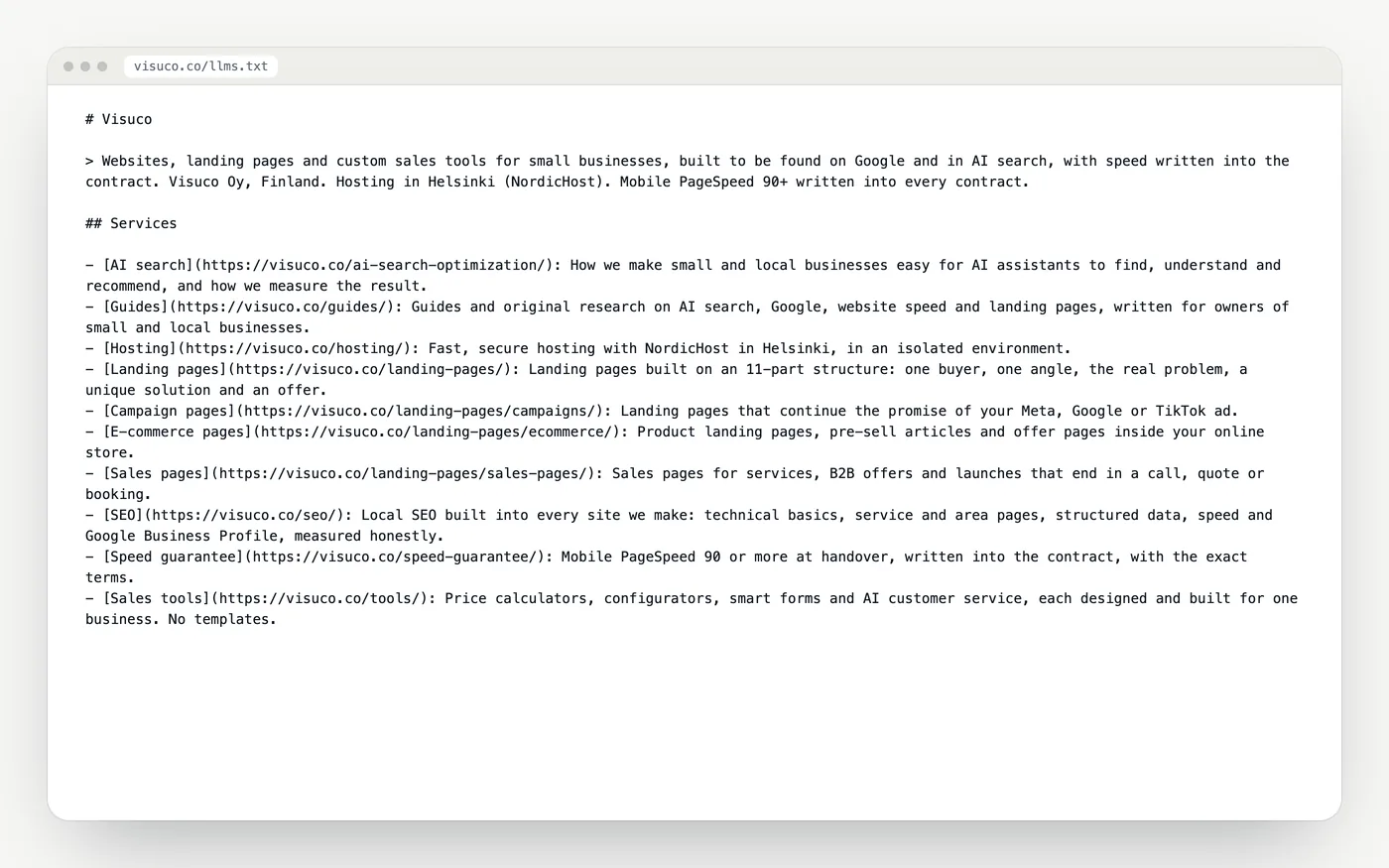
An llms.txt file, without the hype
It costs nothing, but Google Search ignores such files (Google, 2026).
Work beyond your website
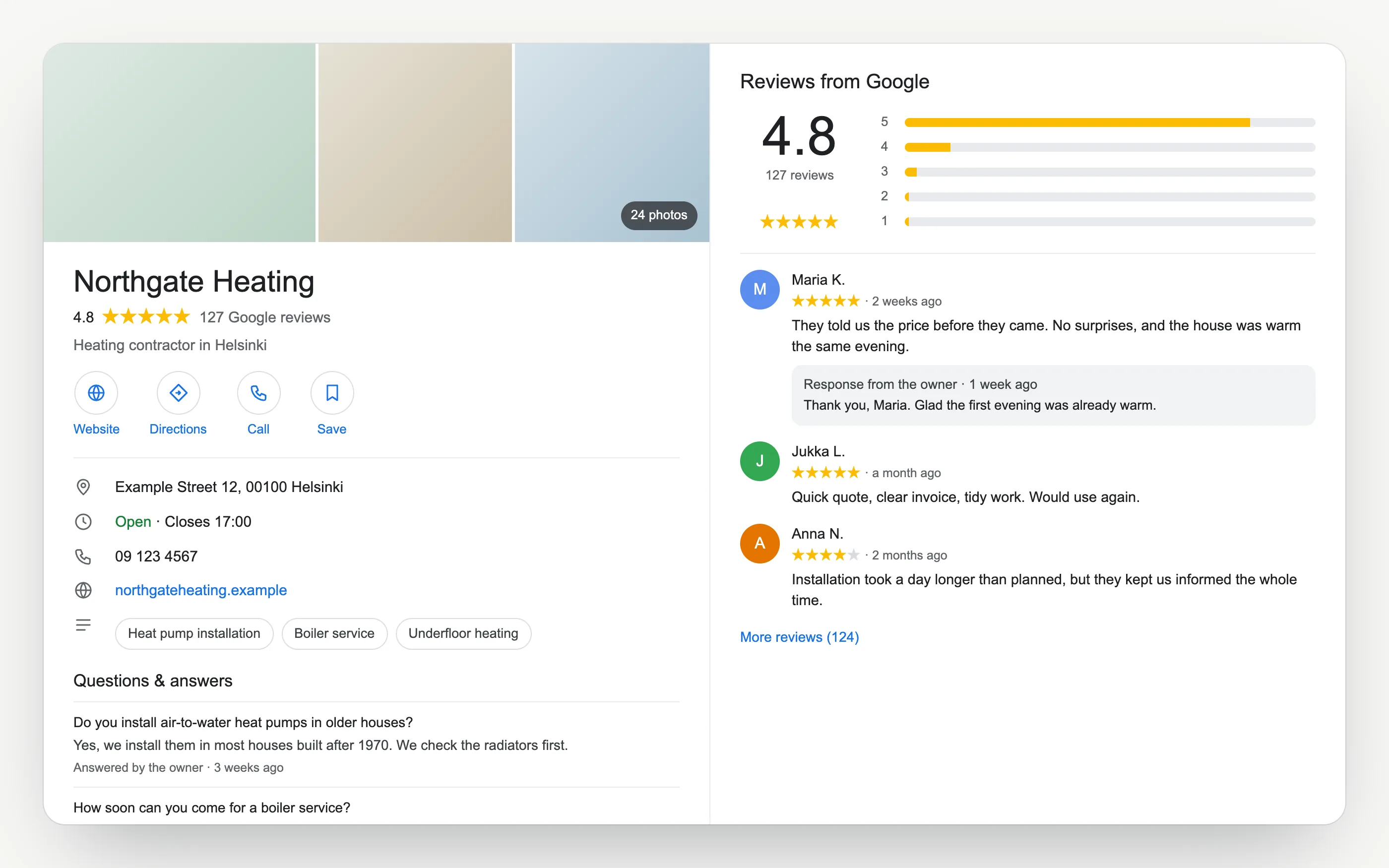
Google says Business Profiles can help a business be visible in AI responses and other search results (Google, 2026).
Google Business Profile
Right categories, every service, real area, hours, own photos, matching link.
Listings and directories
The directories AI engines cite for your field, with the same details.
Reviews
Easy review requests and replies; we never write, buy or filter reviews.
Mentions on other sites
Real ones: suppliers, associations, local news. Google warns against chasing inauthentic mentions (Google, 2026).
How we measure AI visibility
We ask the AI engines your buyers' questions, several times each, and record the answers; one run proves little.
- We write your buyers' questions. For example, "Who's a good roofer in Tampere?"
- We run them on several engines. ChatGPT, Google AI Overviews and AI Mode, Gemini, Perplexity, Copilot.
- We repeat every question. Single runs give "a misleadingly precise picture" (Sielinski, 2026), so we report the share of runs that mention you.
- Three possible results. Mentioned, not mentioned, or not measurable. Not measurable isn't zero.
- We show you the sources. Which pages and listings each engine cited.
You get the date, the engine and the exact question, measured before launch and again afterwards.
What we won't do
We won't promise you a place in an AI answer, and we won't use tricks to get one.
No guaranteed recommendations
We promise the work and the measurement, not the answer.
No fake reviews or mentions
Nothing written, bought or posted under false names.
No mass-produced pages
Pages made for every question variation are scaled content abuse (Google, 2026).
No hidden text or AI-only versions
People and machines see the same page.
No single magic score
We report what the engines said, with dates.
Questions about AI search optimization
Still deciding? Ask us anything. We reply to every message ourselves.
Ask a questionIs AI search optimization different from SEO?
Mostly the same foundation: Google says its AI features are rooted in its core Search ranking systems. AI answers name fewer businesses, and each engine picks its own sources.
Can you guarantee ChatGPT will recommend us?
No, and be wary of anyone who does. We guarantee the work, the speed in writing and honest measurement of what the engines answer.
What are GEO and AEO?
GEO is generative engine optimization, a term from a 2023 research paper; AEO is answer engine optimization. Both mean making your business easy for AI assistants to find, understand and cite.
How long does it take to show up in AI answers?
Site changes are live from launch, each engine picks them up on its own schedule, and reviews, listings and mentions build over months. We measure before launch and again later.
Do I still need Google if people use ChatGPT?
Yes. Google's AI Mode alone has passed one billion monthly users, and a site built well for Google is the base for every other engine.
Will AI replace SEO?
AI assistants read the same pages Google ranks and lean on the same signals: clear service pages, consistent business details, reviews and mentions elsewhere. The work overlaps, which is why we build both into every site.
Learn more
Definitions and a step-by-step guide for business owners.
Start with your AI visibility
Three short steps. We ask the assistants the questions your buyers ask and show you the results in our first meeting.
Sources (17)
- Pew Research Center, "Google users are less likely to click on links when an AI summary appears in the results", 22 Jul 2025 www.pewresearch.org/short-reads/2025/07/22/google-users-are-less-likely-to-click-on-links-when-an-ai-summary-appears-in-the-results
- BrightLocal, "Local Consumer Review Survey 2026", 11 Feb 2026 www.brightlocal.com/research/consumer-review-survey
- Pitenin, "Invisible to the Machine: Auditing AI Restaurant, Cafe, and Bar Recommendation Against a Complete Market Census", arXiv, 7 Aug 2026 arxiv.org/abs/2608.07069
- BrightLocal, "Local Consumer Review Survey 2026", February 2026 www.brightlocal.com/research/consumer-review-survey
- Alphabet, "2026 Q2 Earnings Call Transcript", July 2026 s206.q4cdn.com/479360582/files/doc_events/2026/Jul/22/2026_Q2_Earnings_Transcript.pdf
- TechCrunch, "ChatGPT reaches 900M weekly active users", February 2026 techcrunch.com/2026/02/27/chatgpt-reaches-900m-weekly-active-users
- Pew Research Center, "Google users are less likely to click on links when an AI summary appears in the results", July 2025 www.pewresearch.org/short-reads/2025/07/22/google-users-are-less-likely-to-click-on-links-when-an-ai-summary-appears-in-the-results
- Localogy, "SOCi LVI Report Reveals How AI Is Rewriting Local Search Visibility", January 2026 www.localogy.com/2026/01/soci-lvi-report-reveals-how-ai-is-rewriting-local-search-visibility
- Pitenin, "Invisible to the Machine: Auditing AI Restaurant, Cafe, and Bar Recommendation Against a Complete Market Census", arXiv, August 2026 arxiv.org/abs/2608.07069
- Yext, "AI Doesn't Rank, It Cites. And 86% of Its Sources Are Brand-Managed", October 2025 www.yext.com/blog/ai-citations-86-percent-of-sources-are-brand-managed
- Google Search Central, "Google's Guide to Optimizing for Generative AI Features on Google Search", July 2026 developers.google.com/search/docs/fundamentals/ai-optimization-guide
- Aggarwal et al., "GEO: Generative Engine Optimization", arXiv, November 2023 arxiv.org/abs/2311.09735
- Tannenbaum, "Scoring With the Engine: Retrieval Exposure, Cross-Engine Divergence, and the Limits of Engine-Agnostic GEO Scores", arXiv, September 2026 arxiv.org/abs/2609.22655
- Search Engine Roundtable, "Microsoft Confirms Schema Helps Its LLMs (Copilot) Understand Your Content", March 2025 www.seroundtable.com/schema-llms-copilot-bing-microsoft-39093.html
- Vercel, "The rise of the AI crawler", December 2024 vercel.com/blog/the-rise-of-the-ai-crawler
- OpenAI, "Overview of OpenAI Crawlers", accessed October 2026 developers.openai.com/api/docs/bots
- Sielinski, "Quantifying Uncertainty in AI Visibility: A Statistical Framework for Generative Search Measurement", arXiv, August 2026 arxiv.org/abs/2603.08924